
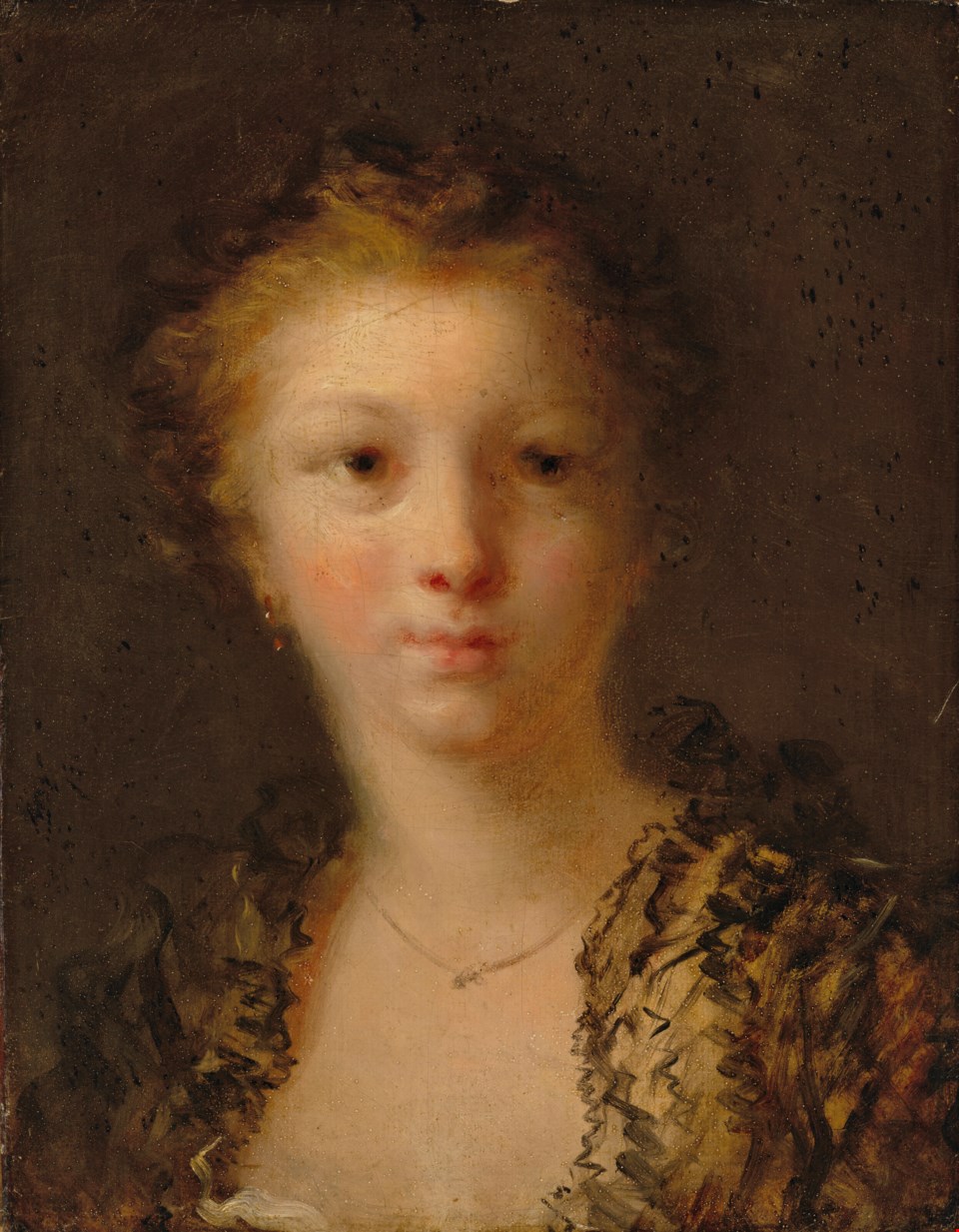
JEAN-HONORÉ FRAGONARD (GRASSE 1732-1806 PARIS)
Tête de jeune femme
- 成交價
- 歐元 787,500
- 估價
- 歐元 400,000 - 歐元 600,000估價不包括買家酬金。成交總額為下錘價加以買家酬金及扣除可適用之費用。
拍品終止拍賣:2026年10月23日
細節
JEAN-HONORÉ FRAGONARD (GRASSE 1732-1806 PARIS)
Tête de jeune femme
huile sur toile
38,3 x 30,5 cm (15 ⅛ x 11 ¾ in.)
來源
[Possiblement] Montmorency-Laval (1716-1783) ; sa vente après-décès, Paris, 5 avril 1784, partie du lot 46 (selon Pierre Rosenberg, 1989, voir infra).
Gustave Rothan (1822-1890), Paris, avant août 1878 ; sa vente après-décès, Galerie Georges Petit, Paris, 29-31 mai 1890, lot 147.
[Possiblement] Albert Lehmann (1840-1922), Paris (selon Pierre de Nolhac, 1906, voir infra).
Christiane de Polès (morte en 1936) ; sa vente, Galerie Georges Petit, Paris, 22 juin 1927 (1er jour), lot 15.
Otto Sebastian Bemberg (1857-1932), puis par descendance à ;
Frédéric Bemberg (1875-1949), Paris, puis par descendance aux propriétaires actuels.
出版
Baron R. Portalis, Honoré Fragonard: sa vie et son oeuvre, Paris, 1889, II, p. 290.
P. de Nolhac, J.-H. Fragonard, Paris, 1906, p. 114.
Le Figaro artistique, 14 juillet 1927, reproduit.
L. Réau, Fragonard, sa vie et son oeuvre, Bruxelles, 1956, p. 183.
G. Wildenstein, The Paintings of Fragonard, Londres, 1960, pp. 306-307, n° 485, fig. 199
G. Mandel, L'opera completa di Fragonard, Milan, 1972, p. 108, n° 514, reproduit.
J-P. Cuzin, Jean-Honoré Fragonard, Vie et oeuvre, Catalogue complet des peintures, Fribourg, 1987, p. 322, n° 323 (daté vers 1778.)
P. Rosenberg, Tout l'oeuvre peint de Fragonard, Paris, 1989, p. 100, n° 267 (daté vers 1770-1773), reproduit.
展覽
Paris, Musée des Arts Décoratifs, Palais des Tuileries, Pavillon de Flore, Tableaux anciens et modernes exposés au profit du Musée des Arts Décoratifs, août 1878, n° 98 (prêté par Gustave Rothan).
Paris, Chambre Syndicale de la Curiosité des Beaux-Arts, L'art français au service de la Science française: exposition d'oeuvres d'art des XVIIIe, XIXe et XXe siècles, 25 avril-15 mai 1923, n° 14.
Londres, Royal Academy, European Masters of the Eighteenth Century, 1954-1955, n° 192 (prêté par Mme Frédéric Bemberg).
Grasse, Musée Fragonard, Oeuvres de Fragonard, 15 juillet-30 septembre 1957, n° 11.
更多詳情
JEAN-HONORÉ FRAGONARD (1732-1806), HEAD OF A YOUNG WOMAN, OIL ON CANVAS
Appearing for the first time in a century at auction and the first time in public since the exhibition at the musée Fragonard in 1957, this bewitching painting by Jean-Honoré Fragonard (1732-1806) perfectly illustrates the virtuosity and freedom of execution of one of the most inspired artists of the eighteenth century.
There is both a wonderful immediacy to the Head of a Young Woman and an air of mystery to her. Fragonard's treatment of her skin and her hair is soft, creamy; she seems to melt into a haze of golden light, shimmering in and out of focus against the muted background. Her lips and cheeks are picked out in rosy pinks. Her gaze does not meet that of the viewer, but looks past us. All the movement of the painting is in her costume, the flickering, staccato strokes of black, swiftly applied. She is a mixture of sensuality and excitement, characteristic of Fragonard's lively and spontaneous style.
The slightly fantastical element of the sitter's clothing may not be as theatrical as it is first perceived. This form of lace wrap, an extension of the mantilla, is in fact described in the 1769 work L'Art Du Tailleur (The Art of the Tailor), by François-Alexandre Pierre de Garsault (1691-1778). In this he notes how a lady must dress when being presented at court, a cumbersome ensemble that includes a heavy bodice. However, he specifies that, 'If the Lady to be presented is not able to endure the heavily boned bodice then she is allowed to wear a lighter one, covered with a mantilla, with the court train and petticoat... The mantilla is made from any light material such as gauze, net, lace, etc.' It is possible therefore, that the charming model in this painting was connected to the court of Louis XV (1710-1774) or the opening years of the court of Louis XVI (1754-1793).
Pierre Rosenberg dates this painting to circa 1770-1773 (P. Rosenberg, op. cit. p. 100), a time when Fragonard was enjoying his greatest success amongst an aristocratic clientele. However, Jean-Pierre Cuzin places it slightly later, around 1778 (J-P. Cuzin, op. cit. p. 322). Both these arguments are convincing on stylistic grounds, a further example, were we to need it, that establishing a clear chronology of Fragonard's work is an almost impossible undertaking.
It is the case that the swift touches of black in sitter's costume recall the zigzag application of paint in the costume of The Study (Portrait of Anne Louise Brillon de Jouy) (fig. 1, Paris, musée du Louvre, inv. MI 1059). One of the Figures de Fantasie, The Study is dated with some degree of certainty to the period around 1769-72. However, the treatment of the flesh tones in The Study or other portraits of woman from the early 1770s, such as the Bust of a Young Girl (Fogg Art Museum, Cambridge, MA, inv. 1975.73) is very different to that in the Head of a Young Woman. Where the earlier paintings are more Rubensian in their fullness and clarity, here the softness of the flesh, melting into darkness, speaks of Rembrandt's (1606-1669) influence on Fragonard.
Documented in Brussels in 1773, Fragonard incorporated many elements of the art of the Dutch Golden Age into his own work, showing as time went on, a distinct predilection for Rembrandt. In the case of the present painting, we can go so far as to suggest a very specific source of inspiration that may have been in Fragonard's mind when he was working. This is the Portrait of Hendrickje Stoffels (1625-1662) in a velvet cap (fig. 2, Paris, musée du Louvre, inv. 1751).
Fragonard would have had several opportunities to examine this painting during his lifetime, most notably, with regards to the Head of a Young Woman, in 1767, when it was sold in the posthumous sale of the great collector Jean de Jullienne (1686-1766). The two pictures share the same frontal depiction of the sitter, the same golden brown palette. The women both have the same rosebud smile, the same white throat glows against dark cloth. But beyond this they share something more ineffable: a sense of both appearing into the light and disappearing into the darkness.